
By Kimate Richards, Founder & CEO, 10Things · October 2026
Turn off the lights in your kitchen and pick up your coffee mug. You’ll find it, lift it, and know whether it’s full, all without a camera strapped to your wrist. Most robot hands can’t do that, so we bolted a camera onto them and called it dexterity. In this post I argue that the wrist camera is a crutch, explain what should replace it, and describe how we’re building that replacement into our humanoid, Aida. Sources are linked throughout and collected at the end.
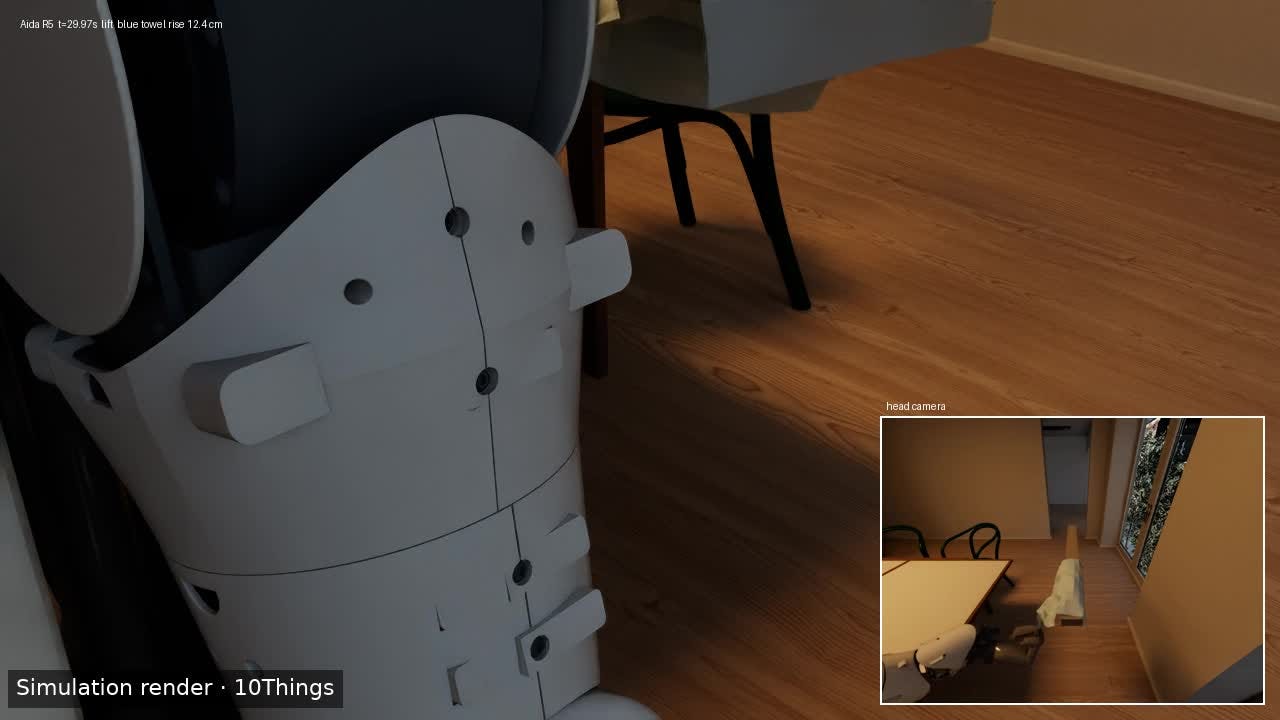
Aida, our humanoid, reaching down for a towel. The inset shows the head camera’s view. Simulation render (NVIDIA Isaac Sim), 10Things.
A wrist camera on a humanoid hand is a confession: the robot has no sense of touch and no memory of where things are. Fix those two and, I’d argue, the camera has nothing left to do.
The crutch we bolted on
Let me be fair to the wrist camera first. Take a standard imitation-learning policy whose only other view is a fixed camera across the room. Pull the wrist camera off and the policy gets worse. Every controlled ablation I found says so.
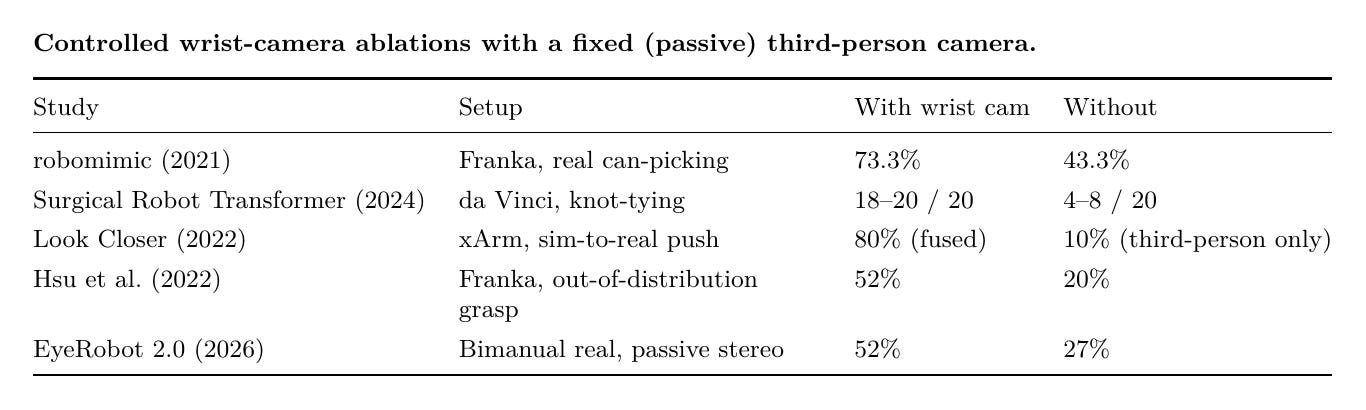
The pattern is consistent: the penalty tracks precision and depth ambiguity. Simple grasps barely move. Insertion, handover and knot-tying lose 30 points or more. Hsu and colleagues explain why. A hand-centric view “only sees what is in contact or near the gripper,” which makes it robust to scene changes, “similar to how touch does.”
Read that sentence again. The wrist camera is valuable because it behaves like touch. It is a vision sensor doing a tactile sensor’s job, badly, through a cable that crosses the most abused joint on the robot.
The same literature shows where the wrist camera fails. First, it cannot search. On a perturbed placing task in EyeRobot, the wrist-camera baseline scored 10% and the actively steered eye scored 100%. Second, it goes blind the moment the object is in hand. EyeRobot 2.0 (Active Gaze for Precise Manipulation without Wrist Cameras, UC Berkeley, October 2026) uses a single fixed stereo camera with software-controlled gaze; the fixation is synthesized by warping the stereo images, so there are no moving parts. It matched wrist-equipped policies when the wrist view was clear (69% vs 64%). When the grasped object blocked the wrist camera, it more than doubled them (48% vs 22%).
The most telling result is on an actual humanoid. Kühn and colleagues at Leibniz University Hannover compared 14 sensor configurations on a Unitree G1 with Dex3 hands. On the harder cube-sorting task:
An active stereo head alone scored 87.5%.
Adding wrist cameras lowered that to 72.7%.
Static head cameras alone managed 10%.
On that robot the wrist camera wasn’t just unnecessary. It was a liability.
My reading of the evidence: the ablations that make wrist cameras look essential compare them against a passive, fixed camera. Very few test the setup humans actually use, which is eyes that move.
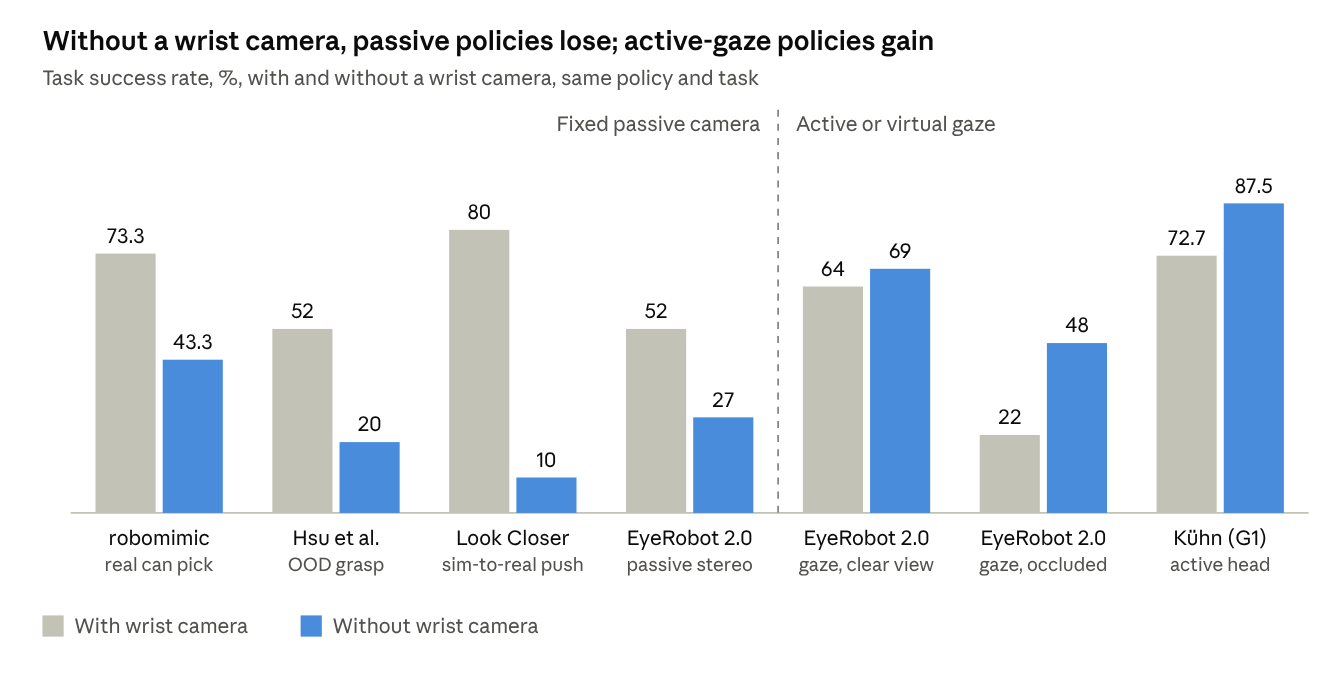
Left of the dashed line, the head camera is fixed and the wrist camera carries the policy. Right of it, the head camera can fixate and the wrist camera stops helping. Data from robomimic, Hsu et al., Look Closer, EyeRobot 2.0 and Kühn et al., all linked below. Chart: 10Things.
What a human hand has instead
Humans have no wrist camera and manage fine. What we have is about 17,000 mechanoreceptors in the glabrous skin of each hand (Johansson & Vallbo, 1983). They come in four kinds and are packed densest at the fingertips: roughly 140 Meissner and 70 Merkel units per square centimeter, under a millimeter apart. That count leaves out the muscle spindles and tendon organs that tell you where your hand is, the thermoreceptors, and the pain fibers.
But the count is the wrong thing to copy. What matters is how the brain uses those signals, and Johansson and Flanagan laid that out in a 2009 review that every roboticist should read. Picking up a cup is a chain of phases: reach, load, lift, hold, replace, release. Each phase boundary is a discrete tactile event:
Fingers touch the cup.
The cup breaks contact with the table.
The cup lands.
Fingers let go.
The brain predicts when each event should arrive and corrects when one doesn’t arrive on time. In their words, “dexterous manipulation is not possible unless predictions are accurate.”
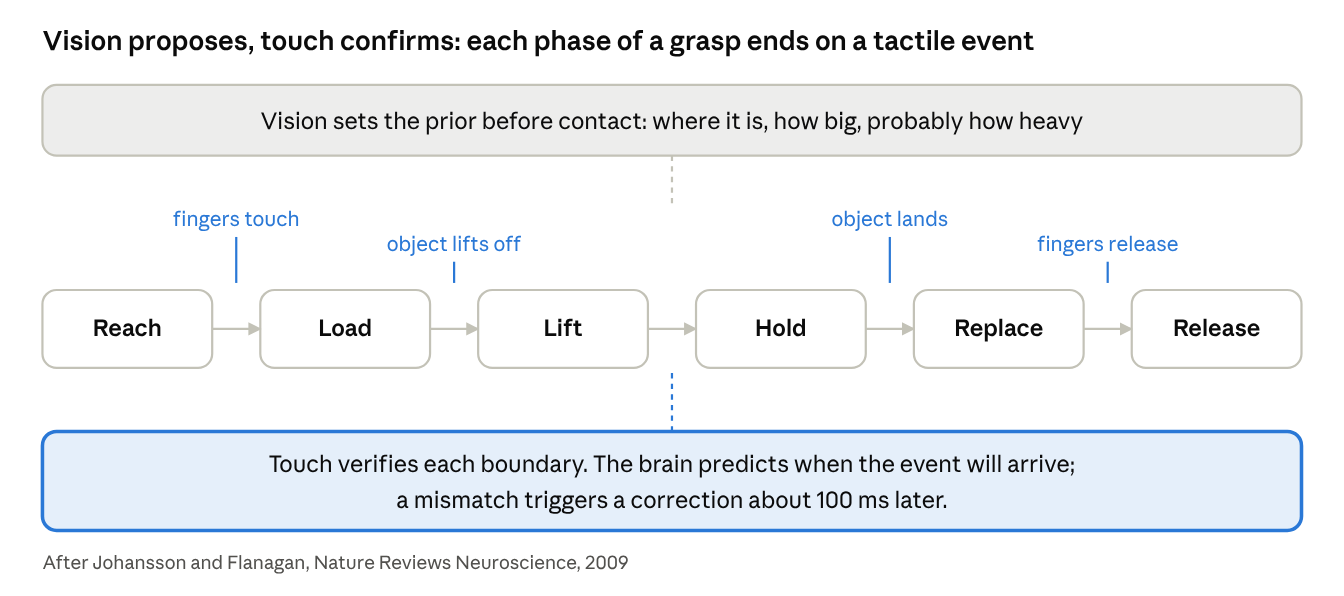
On vision, they write: “Vision provides only indirect information about such mechanical interactions.” The eyes set the prior: where the cup is, how big it is, roughly how heavy. Touch verifies and overrides after contact.
The anesthesia experiments make the point brutally. Numb the fingertips and people lose the ability to scale grip force to friction. They over-squeeze, and fine tasks fall apart. Their eyes work perfectly the whole time (Johansson & Westling, 1984).
A robot with cameras and no touch is a human with numb fingers. The wrist camera is the crutch we bolted on to compensate.
Humans do one more thing that most robots don’t: we don’t look at our hands. Eye-tracking studies of people making tea or sandwiches show gaze landing on the next target, whether that’s the grasp site, the obstacle or the landing spot. Gaze runs ahead of the hand instead of tracking it (Hayhoe & Ballard, 2005). Fixations are “just in time”: the eye fetches exactly what the next phase needs, when it needs it. That is the biological case for an actuated stereo head, and I think it is why the EyeRobot and Kühn results come out the way they do.
Reaching in the dark
Here is the test that I think kills the wrist camera. Turn the lights off in your kitchen. You can still find the mug, pick it up, and tell whether there’s coffee in it. No camera on your wrist did that. Three things did.
A body schema. Proprioception tells you where your hand is relative to your head without looking. That’s why you can reach into a dark cabinet at all.
A two-tier spatial map. A short-lived memory of where the target was, relative to you, sits on top of a longer-lived map of the room: the mug is left of the sink. Any glance refreshes the short-lived part. This is why just-in-time gaze works. The eyes don’t need to watch the hand. They need to re-anchor the map before the hand goes out of view.
Exploratory procedures. Lederman and Klatzky showed in 1987 that touch-only recognition is not random groping. It is a fixed vocabulary of motions:
a lateral stroke for texture
a press for hardness
enclosure for global shape
contour-following for exact shape
an unsupported hold for weight
People identify everyday objects by touch alone within a few seconds (Klatzky, Lederman & Metzger, 1985).
None of these three lives in the hand. They are memory, proprioception and a motor vocabulary. A wrist camera addresses none of them, because a reactive sensor can’t stand in for a persistent model.
The robot equivalents exist now, and they’re recent.
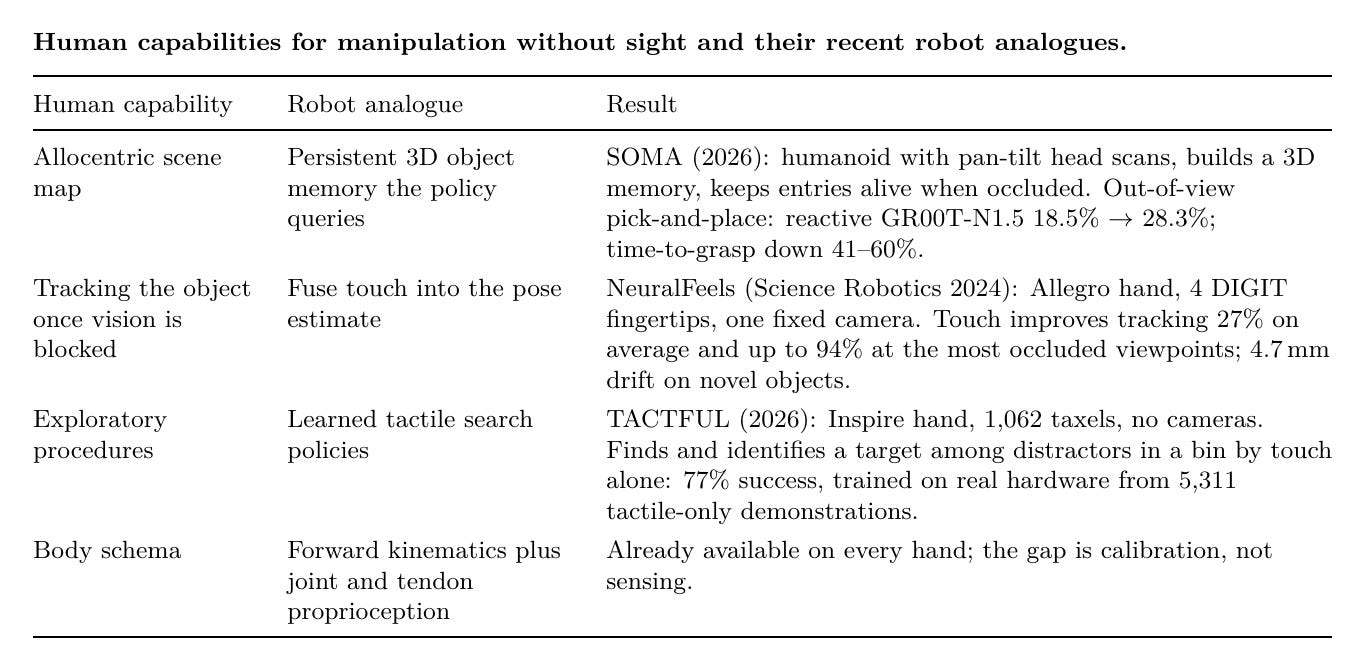
Two implications follow.
The policy can’t be a pure “current frame in, action out” function. It needs a memory it can query, with a rule for refreshing it. That is a software change, not a sensor change. SOMA adds this kind of spatial memory and raises out-of-view success from 18.5% to 28.3%, which is a gain but still low.
The training data has to include blind episodes. TACTFUL reached 77% on blind search with an Inspire hand and no cameras, and it needed 5,311 tactile-only demonstrations to get there. If your teleoperator can always see, your policy never learns to feel.
Can a hand know what it is holding?
To pick up a can without looking at it, a hand needs five capabilities, and each has to work without a camera on the hand:
know the shape
know the material
know the mass
find the object when you can’t see it
settle on a grasp
Here is where each one stands, human first, then the best robot result I could find.
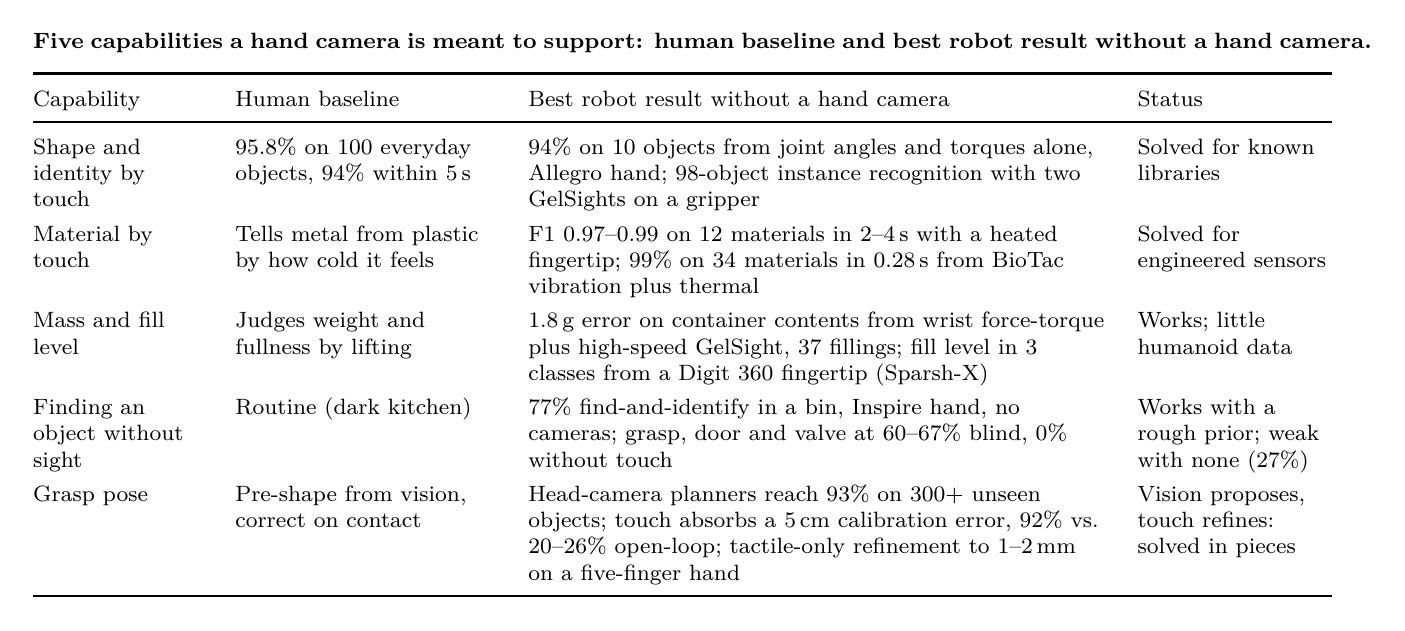
Four things in that table matter for the argument.
Shape and identity don’t need a camera, or even skin. Sintov and Ben-David identified 10 YCB objects at 94% on a real Allegro hand using nothing but joint angles and joint torques: where the fingers stopped and how hard they pushed. Add tactile sensing and the library grows to about 100 objects (Lin, Calandra & Levine). For a known object like a can, identity is the easy part.
Material is the cheapest sense we aren’t using. A heated fingertip reading heat flow separates metal from polymer from wood at F1 above 0.97 within a few seconds (Bai et al.). Its confusions are within metals and within plastics, which rarely matters for a grasp. Add a vibration channel and texture discrimination reaches 117 textures at 95% (Fishel & Loeb).
Mass is the one humans get from lifting, and robots can too. Guo, Huang and Yuan estimated the mass of a container’s contents to within 1.8 g using wrist force-torque and a high-speed tactile sensor. For scale, a full 355 ml can weighs roughly 380 g and an empty one roughly 15 g. I’ve found very little of this work on humanoids. The thermal channel helps here too: a cold can is usually a full can.
Grasp pose is where the whole argument closes.
A head-height depth camera is good enough to propose a grasp. AnyGrasp clears bins of unseen objects at 93%. What it can’t do is land within a millimeter, and it doesn’t need to.
The MAT study deliberately added a 5 cm camera-to-robot calibration error. Open-loop vision grasps fell to 20–26%; tactile closed-loop control recovered 92%.
TacRefineNet, on a five-finger hand, then refines the in-hand pose to 1–2 mm with touch alone.
That’s Johansson’s loop on a robot: vision predicts, touch corrects. When Does Touch Matter? (USC, LEAP hand) measured the gap in confined spaces, the kind of situation hand cameras are usually added for. Vision-only succeeded 6 of 15 times; with touch and wrench sensing it succeeded 15 of 15.
The honest caveat is grasping blind from nothing. With no prior at all, touch-only grasping is still weak; the Blind Dexterous Grasping results sit well below vision-guided ones. Touch is a verifier and a refiner, not a search engine. The spatial map and the head camera supply the prior, and nothing in the table above works without one.
One more sensor belongs on the list, because it covers the last centimeter before contact: pre-touch proximity. A low-cost time-of-flight fingertip gives millimeter ranging from 1 to 10 cm, and adding one turned a Rubik’s-cube manipulation from 0/10 to 8/10 (Yang, Lancaster & Smith, UW). An ultrasound/optoacoustic fingertip ranges to 0.2 mm (Fang et al.). The wrist camera usually gets praised for exactly this function. Here it’s done by a small fingertip sensor with no image pipeline.
What the industry is doing
As of October 2026, most full-size humanoid makers have, as far as public materials show, put their cameras in the head and their sensing budget into the hands. They did it with hardware before the ablations caught up.
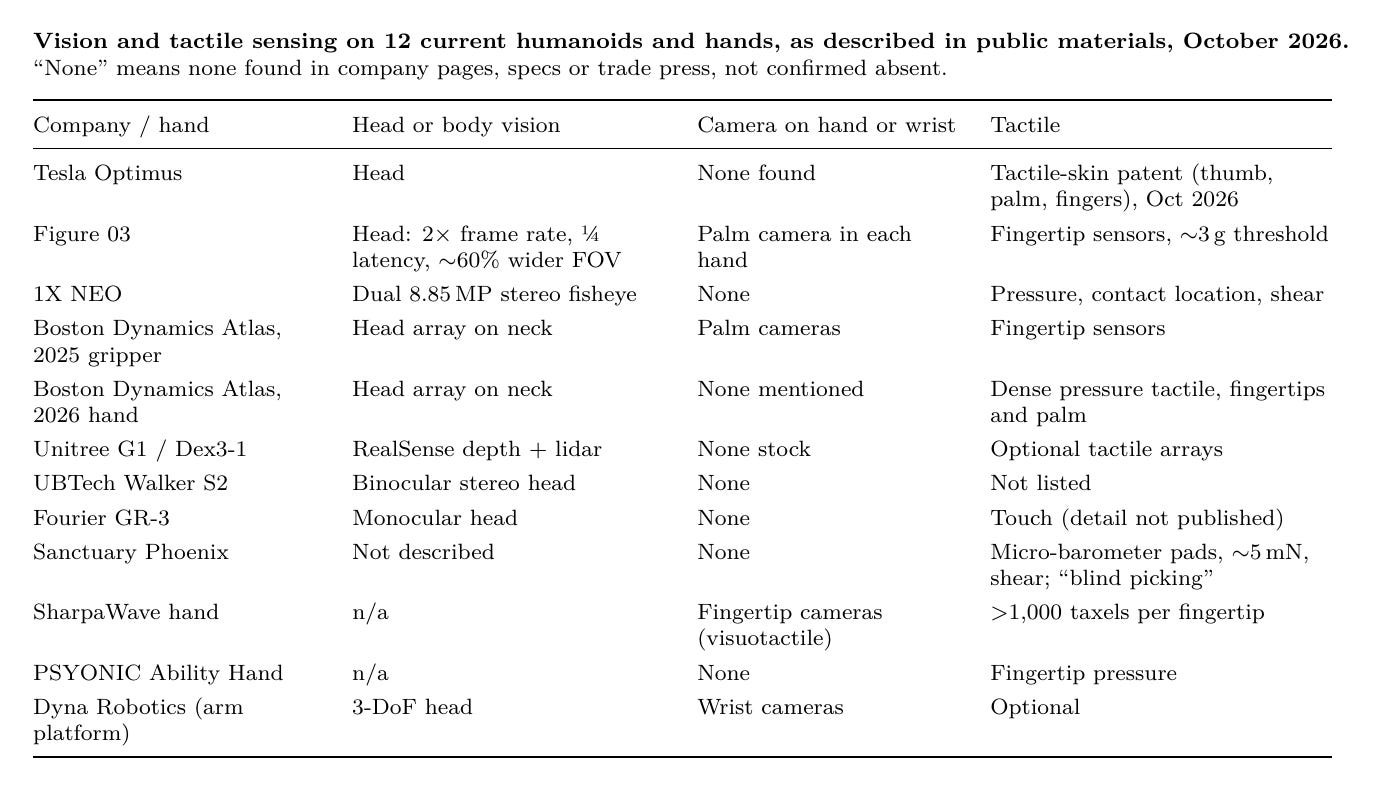
Three things stand out to me.
First, the split tracks body shape, not philosophy. Robots with an articulated neck tend toward head vision plus tactile. Arm-centric VLA shops keep wrist cameras because their rigs have no steerable head. Dyna’s chief scientist says wrist cameras “can avoid occlusion” and can make tactile unnecessary (humanoid.guide). Sanctuary says tactile is what works “when vision is occluded” (The Robot Report). Both are right about their own hardware. The wrist camera is a symptom of a missing neck.
Second, where hand cameras survive, they’re mostly in the palm or fingertip, not the wrist. Figure 03 is the clearest case of adding hand vision. Its stated reason is redundancy: so Helix can “maintain visual awareness even when the main cameras are occluded, such as when reaching into a cabinet” (Figure). To me that’s a memory problem being solved with a camera, and I’d bet it’s a transitional design.
Third, the most interesting data point is unconfirmed. Boston Dynamics’ October 2025 Atlas gripper had “cameras embedded in the palm” (Interesting Engineering). The October 2026 four-finger hand is described with dense tactile sensing, actuator proprioception, “no fragile cables crossing joints,” and the principle “the best part is no part.” I couldn’t find a camera mentioned anywhere. Boston Dynamics hasn’t said the palm cameras were dropped, so the accurate phrasing is “no longer mentioned,” not “removed.” But I know which way I’d bet. Its engineers are also the only ones I found explaining their camera placement on record: cameras go in the head “to maximize field of view and reduce occlusion by the robot’s own body” (Vision Systems Design, Mar 2026).
Watch it work without a wrist camera
These are public videos of systems manipulating with no camera on the hand. Autonomy status is as stated on each source page.
EyeRobot 2.0 (UC Berkeley, Oct 2026). Toaster, marker, wrench, tea and tape tasks from one fixed stereo camera with software gaze; parallel grippers; autonomous policy rollouts. eyerobot2.github.io
Open-TeleVision (UCSD, 2024). A Unitree H1 sorting cans autonomously with one ZED Mini on a 2-DoF neck and no wrist cameras. Paper.
HumanPlus (Stanford, 2024). Autonomous folding and warehouse unloading from two head webcams, with no wrist cameras. Paper.
Kühn et al. (Hannover, 2026). A Unitree G1 sorting cubes with an active stereo head only. The video is linked from the paper, and the datasets are on Hugging Face.
1X NEO hands (Jul 2026). Tendon-driven hands with pressure and shear tactile sensing and no hand camera. Control mode isn’t stated. 1x.tech.
Boston Dynamics Atlas hand (Oct 2026). Grasps, in-hand repositioning and slip recovery, with tactile fingertips and palm. No camera is mentioned. BD blog
TACTFUL (Amazon/UIUC/CMU, 2026). Blind search in a bin with no cameras at all. Paper
For contrast, Figure 03’s launch video shows its palm camera: figure.ai/news/introducing-figure-03.
What it actually takes
Going camera-less at the wrist is a system decision, not a subtraction. Map the human channels by function rather than by count, and the bill is short.
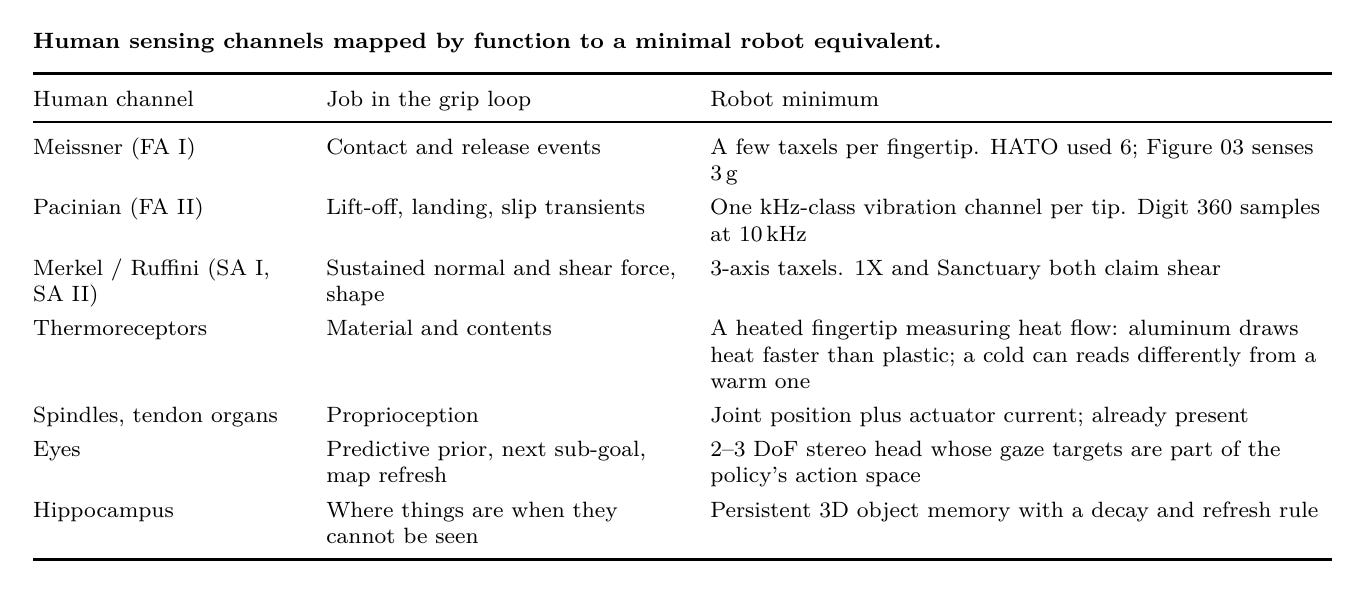
Johansson’s model needs a few reliable events per fingertip, not 17,000 channels. Density buys texture and shape discrimination. My estimate is that the grip loop the wrist camera currently covers needs on the order of a dozen fast, well-placed channels per finger. That’s a tractable engineering target.
What comes off the robot is concrete. Each wrist camera is a high-speed cable run through the highest-cycle joints on the robot. Field reports suggest the cable, not the imager, is what fails:
A Hello Robot forum thread traced a month of camera crashes to the USB cable.
igus names torsional “corkscrewing” on wrist axes as the signature failure mode for cables.
One integration guide puts hand-eye calibration drift at 2–5 mm a month, with recalibration after any bump (RoboticsCenter.ai).
In a tendon-driven hand, a camera cable also competes for space with the tendons that cross the wrist.
The compute argument flips too.
GR00T N1 spends 64 image tokens per 224 × 224 view. A head-only setup is 64 tokens per step; head plus two wrists is 192.
Adding a wrist view to OpenVLA-OFT cut throughput from 109.7 Hz to 71.4 Hz for a 1.8-point gain (Kim, Finn & Liang).
Foveated active vision goes further. Look, Focus, Act cut ViT tokens from 324 to 20 and raised thread-needle success from 24% to 56%.
The data pipeline barely changes, because humanoid teleop is already largely head-only. Open-TeleVision streams one ZED Mini through an Apple Vision Pro. NVIDIA’s GR-1 data for GR00T N1 comes from “one head-mounted egocentric camera.” EgoDex holds 829 hours of human manipulation recorded from a headset, with no wrist view, because humans have no wrist camera. A head-only observation space is the only one that human video can fully supply.
There’s a bigger problem under the camera question. The widely used open VLA models are built around pixels. OpenVLA, π0 and GR00T N1 take camera images, language and robot state, and none of them has a native input for touch, pressure or heat. In my view, that’s exactly what the wrist camera props up. If the only thing a model can perceive is pixels, the only way to give it contact information is to point a lens at the contact. Removing the wrist camera forces the architecture question most teams have been putting off: the policy has to take depth, force, vibration and temperature as first-class inputs, and the training data has to carry them. Meta’s Sparsh tactile encoder and visuotactile policies like NeuralFeels, HATO and RotateIt are early answers. As far as I know, none of the large VLAs has shipped one yet.
Three honest caveats.
Both halves of “active stereo” matter. Going monocular dropped HumanPlus’s shoe task from 60% to 0% and Open-TeleVision’s can-picking from 92% to 46%.
Naive tactile fusion can hurt. In Kühn et al., adding the hands’ pressure sensors to the active-head setup lowered the can task from 94.4% to 67.3%.
Nearly all of the ablations are on arm-and-gripper rigs with 20–250 demonstrations. Kühn’s G1 study is the only full-humanoid one I found.
The industry picture above also relies on press material, not technical documentation, and a camera’s absence from public materials doesn’t prove it’s absent from the hardware.
What we’re doing at 10Things
At 10Things we’re building Aida, a bimanual humanoid:
two 7-DoF arms on a lift rail, with a Jetson Thor on board
trained on the NVIDIA Isaac, Cosmos and GR00T stack
teleoperated through an Apple Vision Pro
two depth cameras, a Luxonis OAK-4 D in the head and a second in the chest
The hands also carry fisheye cameras. They’re installed and switched off. The policy never sees them, which makes our setup the ablation the research above describes: the hardware is there, and if we ever need the comparison, we turn them on.
That wasn’t a cost decision. It was a bet on the argument above: identity comes from feel and mass, location comes from the spatial map, and vision sets the prior and refreshes the map. So the work is going into the hands.
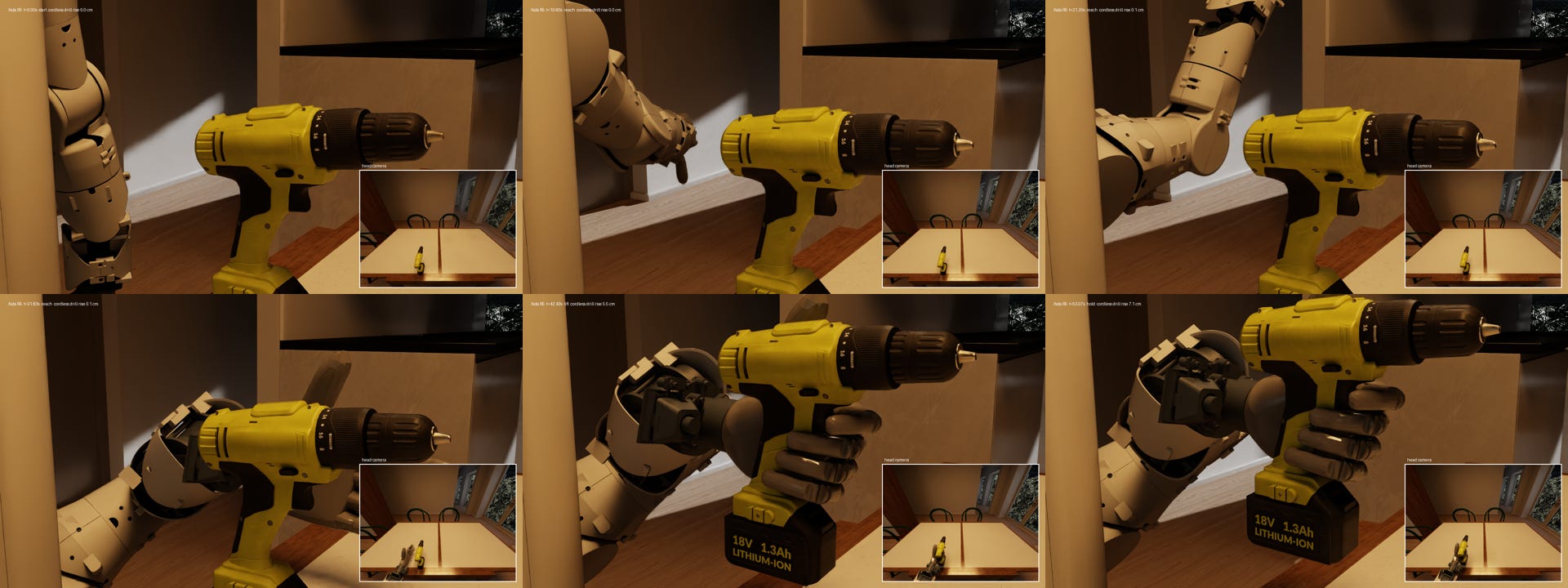
Aida’s PSYONIC Ability Hand grasping a cordless drill. The inset in each panel is the head camera’s view. Simulation render (NVIDIA Isaac Sim), 10Things.
We’re working with PSYONIC on the Ability Hand (six actuators, 30 force sensors per hand), and we’re building toward hands that carry considerably more: sensors that resolve object shape under the fingers and sensors that read the material of what they touch.
Shape comes from distributed pressure and contour-following, the same exploratory procedures Lederman and Klatzky catalogued.
Material comes from heat flow. A warmed fingertip loses heat into aluminum much faster than into plastic or cardboard, and a cold, full can should read differently from a warm, empty one.
The starting point is already more than most people assume. The Ability Hand’s open API returns, on every reply:
30 touch sensors (six per finger)
joint position
motor current
rotor velocity
It accepts position, duty or torque commands at up to 500 Hz over UART. It ships with Python, C++ and ROS 2 clients, plus MuJoCo and Isaac simulator support.
That covers the proprioception row of the table above, so a Sintov-style result (object identity from joint angles and torques alone) should be reachable on this hand with no new hardware. What the stock hand doesn’t give you is shear, vibration, heat flow or pre-touch range. Those four channels are what our sensor work adds.
The example we use internally is a can of Coke. It has a known feel, a known shape, and a known mass, full or empty. A person can pick one up without looking at it, and so should a robot. Seeing that it’s a can may still matter for the task. Knowing where it is in space, and confirming what it is on contact, is what makes the wrist camera unnecessary.
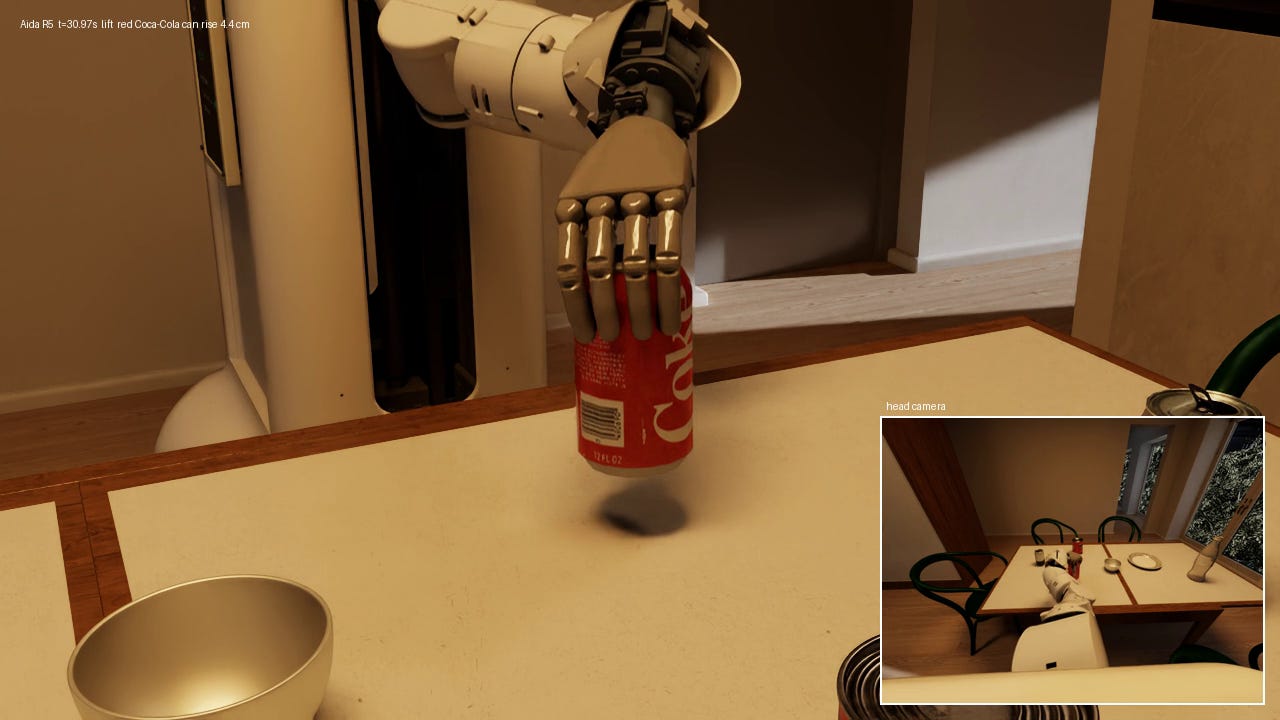
Lift-off. From here, in our design, contact, slip, mass and material are the hand’s job, not the camera’s. Simulation render (NVIDIA Isaac Sim), 10Things.
The depth cameras don’t act alone. Their output is only ever consumed together with tactile and temperature data, as one observation, so the policy learns from the start that vision proposes and touch confirms. We’re deliberately not training a vision-only policy and bolting touch on later.
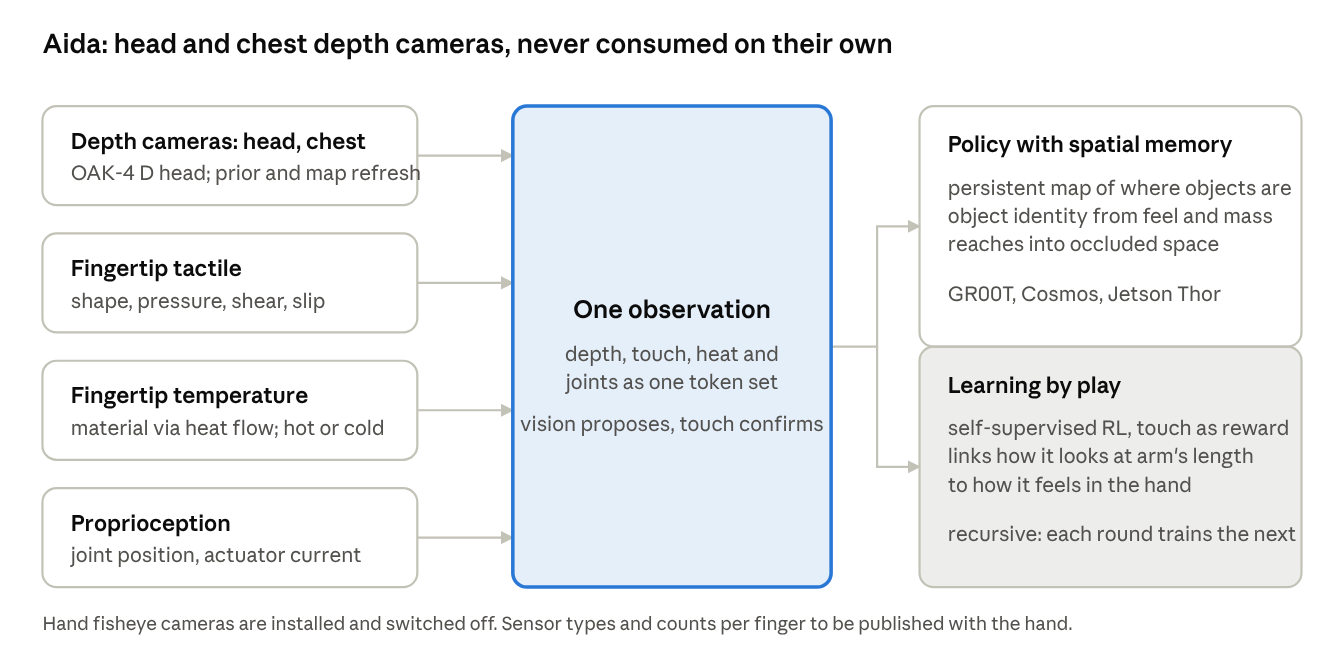
We’re also letting the robots play. Rather than scripting every grasp, Aida handles objects repeatedly and feels its way through them, building up associations between how something looks at arm’s length and how it feels in the hand. Children learn the Coke can the same way.
The learning is self-supervised reinforcement learning: the reward comes from the hand’s own sensors, not from a human label. It asks three questions:
Did the predicted contact arrive when touch said it would?
Did the object lift when the grip force said it should?
Did the material and mass the fingers measured match what the depth camera and the memory predicted?
Every mismatch is a training signal, which turns Johansson’s prediction-and-correction loop into an objective. Each round of play updates the object model, the updated model sets harder predictions for the next round, and the policy is retrained on its own corrected experience. No teleoperator is needed for this phase, which also means the robot is never trained only in conditions where a human could see.
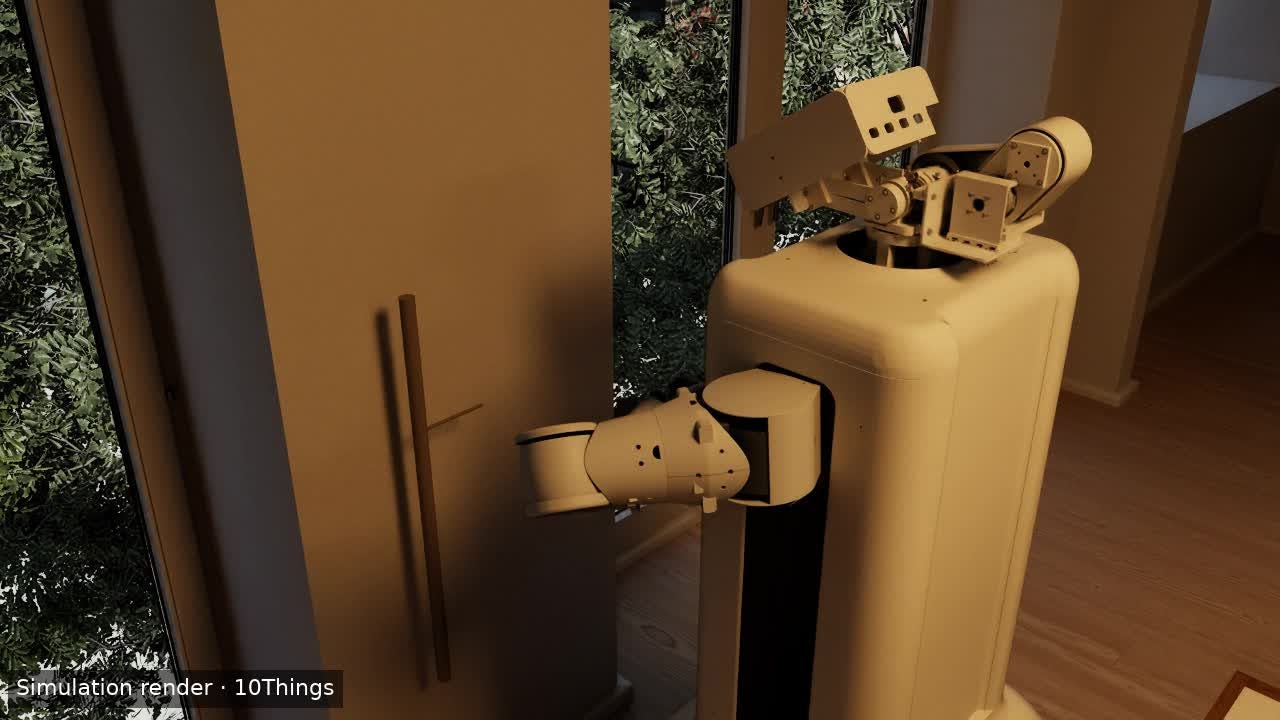
Aida opening a door by its handle. Simulation render (NVIDIA Isaac Sim), 10Things.
All of the Aida footage here is from simulation, and this work isn’t quantified yet. We’ll publish numbers, the sensor PCBs and the CAD, along with real-world footage, as it matures.
If you’re building hands, tactile sensors or VLAs, I’d like to hear where you think I’m wrong.
Sources
Wrist-camera ablations and active vision
Mandlekar et al., What Matters in Learning from Offline Human Demonstrations for Robot Manipulation (robomimic), CoRL 2021
Hsu et al., Vision-Based Manipulators Need to Also See from Their Hands, ICLR 2022
Jangir et al., Look Closer, RA-L 2022
Kim et al., Surgical Robot Transformer, 2024
Kim, Finn & Liang, Fine-Tuning Vision-Language-Action Models (OpenVLA-OFT), 2025
Kerr, Hari et al., Eye, Robot, 2025
Hari, Kerr et al., EyeRobot 2.0: Active Gaze for Precise Manipulation without Wrist Cameras, 2026 · project page
Kühn, Schappler, Seel & Bank, Active Stereo-Camera Outperforms Multi-Sensor Setup in ACT Imitation Learning for Humanoid Manipulation, 2026
Chuang et al., Active Vision Might Be All You Need, 2024
Chuang et al., Look, Focus, Act, 2025
Yu et al., EgoMI, 2025
Zhao et al., HALOMI, 2026
Fu et al., HumanPlus, 2024
Cheng et al., Open-TeleVision, 2024
Tactile sensing, memory and blind manipulation
Li et al., SOMA, 2026
Kamtikar et al., TACTFUL, 2026
Suresh et al., NeuralFeels, Science Robotics 2024
Qi et al., General In-Hand Object Rotation with Vision and Touch (RotateIt), CoRL 2023
Lin et al., Learning Visuotactile Skills with Two Multifingered Hands (HATO), 2024
Zhang et al., DexTac, 2026
Lee et al., DexTouch, 2024
Pai et al., TactoFind, 2023
Luo et al., Blind Dexterous Grasping via Real2Sim2Real Tactile Policy Learning, 2026
Jiang, Dominguez & Seita, When Does Touch Matter?, 2026
Sintov & Ben-David, Simple Kinesthetic Haptics for Object Recognition
Lin, Calandra & Levine, Learning to Identify Object Instances by Touch, ICRA 2019
Bai et al., Analyzing Material Recognition Performance of Thermal Tactile Sensing
Gómez Eguíluz et al., A multi-modal approach to continuous material identification through tactile sensing
Fishel & Loeb, Bayesian Exploration for Intelligent Identification of Textures, Frontiers in Neurorobotics 2012
Guo, Huang & Yuan, Estimating Properties of Solid Particles Inside Container Using Touch Sensing, 2023
Lambeta et al., Digitizing Touch with an Artificial Multimodal Fingertip (Digit 360), 2024
Higuera et al., Tactile Beyond Pixels (Sparsh-X), 2025
Meta FAIR, Sparsh and open-source robotics releases
Fang et al., AnyGrasp, 2023
Bauza, Bronars & Rodriguez, Tac2Pose
Wu et al., MAT: Multi-Fingered Adaptive Tactile Grasping, 2019
Wang et al., TacRefineNet, 2025
Lee et al., High-Bandwidth Tactile-Reactive Control for Grasp Adjustment, 2025
Yang, Lancaster & Smith, Pre-touch Sensing for Sequential Manipulation, University of Washington
Fang et al., A Fingertip Sensor and Algorithms for Pre-touch Distance Ranging and Material Detection, 2023
Models and data
Human hand and gaze
Johansson & Vallbo, Tactile sensory coding in the glabrous skin of the human hand, 1983
Johansson & Westling, Roles of glabrous skin receptors and sensorimotor memory in automatic control of precision grip, 1984
Johansson & Flanagan, Coding and use of tactile signals from the fingertips in object manipulation tasks, 2009
Hayhoe & Ballard, Eye movements in natural behavior, 2005
Lederman & Klatzky (1987), discussed here; Klatzky, Lederman & Metzger (1985), summary
Industry
Figure, Introducing Figure 03
Boston Dynamics, Robot hands for modern AI and real work; Vision Systems Design on Atlas camera placement; Interesting Engineering on the 2025 gripper
PSYONIC, Ability Hand and API
Hello Robot forum on RealSense cable failures; igus on wrist cable wear; RoboticsCenter.ai on calibration drift